If you use CBD oil occasionally or daily, you may wonder how long CBD oil stays in your system after your last dose. The answer is more complicated than a fixed number of hours because CBD absorption and elimination vary with dose, frequency, formulation, food intake, and individual metabolism. It is also important to separate how long does CBD oil stay in your system from how long its effects last or whether a workplace drug test could detect THC from a CBD product.
Quick answer: CBD oil can remain in the body for several days, although there is no universal clearance time. Research has reported CBD half-lives ranging from hours to several days, depending on how it is taken, while repeated oral use may extend the elimination period. Standard U.S. workplace cannabis tests generally target THC or its metabolites rather than CBD itself.
| Question | What the evidence suggests |
| How long can CBD remain in the body? | Several days is possible, but the timeline varies widely |
| What about repeated oral CBD use? | Studies have reported terminal half-lives of roughly 2–5 days |
| Can CBD appear in urine? | Yes; one controlled study detected CBD in some participants up to 5 days after a single 100 mg oral dose |
| Do standard workplace tests look for CBD? | Generally no; federal cannabis testing focuses on THC or THC metabolites |
| Can CBD oil still cause a positive test? | Products containing enough THC can create that risk |
| Can you guarantee a date when your system is “clear”? | No; dose, product composition, frequency, biology, and test method all matter |
What Does “Stay in Your System” Actually Mean?
The phrase “stay in your system” can describe several different things, and mixing them creates misleading answers. CBD may stop producing noticeable effects while the parent compound or its metabolites remain in blood, urine, or other biological samples. A laboratory may also measure tiny amounts long after they would have any noticeable effect.
Drug testing introduces another clock entirely because routine cannabis testing generally does not look for cannabidiol. In federal workplace testing, urine testing targets a metabolite of delta-9 THC, while oral-fluid testing targets delta-9 THC itself. Therefore, a person can have CBD in the body without testing positive for marijuana.
How Long Does CBD Oil Stay in Your System?
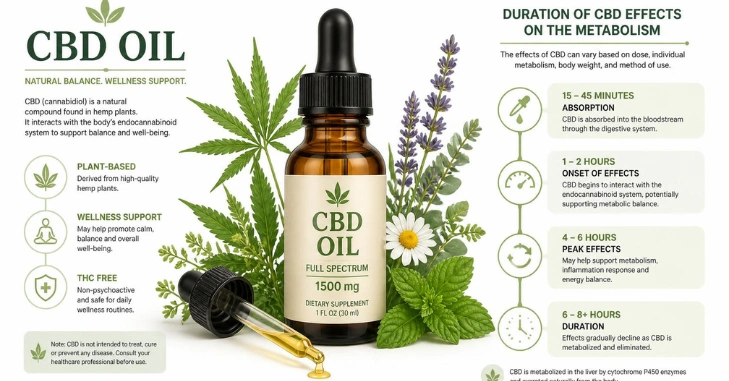
How long does CBD Oil stay in your System? No scientifically supported number applies to every person who takes CBD oil. A systematic review of human pharmacokinetic studies found that CBD half-life varied from approximately 1 hour to as long as 5 days across different routes and dosing patterns. In that review, repeated oral administration was associated with a reported half-life of approximately 2–5 days, while inhaled CBD had a reported half-life of about 31 hours.
That does not mean everyone who takes CBD oil will retain measurable CBD for several weeks. Real-world CBD oils vary substantially in concentration, formulation, serving size, frequency of use, and actual cannabinoid content.
How Long Can CBD Be Detected in Urine?
One of the most useful controlled studies followed healthy adults after they received a single 100 mg dose of oral CBD. Researchers collected urine for five days and found that CBD itself was still detectable at the final collection point in several participants.
The same research also illustrates why “CBD detection” and “passing a drug test” are different questions. After pure CBD administration, none of the samples exceeded the confirmatory threshold for the THC metabolite used under federal workplace urine-testing standards. When participants instead used CBD-dominant cannabis that contained 3.7 mg of delta-9 THC, some samples did produce confirmed positive THC-metabolite results.
CBD Detection in Urine, Blood, Saliva, and Hair
Different specimens provide different information, and research is not sufficient to assign a reliable CBD detection window to every test type. Laboratory sensitivity, dose, timing, formulation, frequency of use, and which compound the laboratory measures can all change the result. For that reason, treat precise online charts claiming CBD always disappears from each specimen after a specific number of hours with caution.
| Test or specimen | What you should know about CBD |
| Urine | Direct CBD detection can last for days; CBD was measurable up to five days in some participants after a controlled 100 mg oral dose |
| Blood | CBD pharmacokinetic studies measure CBD in plasma or serum, but there is no single blood-detection window that applies across doses and formulations |
| Saliva/oral fluid | Direct CBD data are limited, and standard workplace oral-fluid cannabis testing focuses on THC rather than CBD |
| Hair | Evidence for using hair to establish a routine CBD detection window is very limited |
| Workplace cannabis test | The main concern is usually THC exposure from the CBD product, not CBD itself |
A small study involving a single 22 mg oral CBD capsule, for example, detected CBD in oral fluid only at an early collection point. In that same study, CBD could also be identified in urine and other specimens under specialized laboratory methods. That experiment involved only one participant and cannot establish a general saliva or hair timeline for consumers.
6 Factors That Affect How Long CBD Oil Stays in Your Body
Several variables can change CBD exposure and elimination, which is why two people taking apparently similar products may not clear them on the same schedule.
- How much CBD you take. A larger dose generally produces greater exposure than a smaller dose and may take longer for the body to process.
- How often you use it. Daily or repeated CBD use can produce a different elimination profile from a single occasional dose.
- How you take it. Swallowed oil, capsules, gummies, inhaled products, and oromucosal products have different absorption and pharmacokinetic patterns.
- Whether you take it with foo, foodd, particularly higher-fat meals, can increase oral CBD exposure compared with taking it while fasting.
- Your individual physiology. Body composition, metabolism, liver function, and other biological differences can influence drug processing.
- Other medications. CBD is metabolized through liver pathways involved in processing many medicines, creating the potential for
Food is especially relevant for an oil you swallow because CBD absorption can change substantially depending on what you eat with it. Human pharmacokinetic research has found greater CBD exposure in fed conditions, helping explain why the same labeled amount does not necessarily produce identical blood concentrations each time. This is another reason a calculator based only on the number of milligrams in a bottle cannot predict a precise clearance date.
Medication use and liver health also deserve more attention than they receive in many CBD clearance guides. The FDA warns that CBD can interact with other medicines and has the potential to cause liver injury. At the same time, current FDA research continues to investigate these safety concerns at consumer-relevant doses. Anyone who takes prescription medication or has a medical condition should discuss CBD use with a qualified healthcare professional rather than changing medication or CBD schedules based solely on an online detection estimate.
Does CBD Oil Show Up on a Drug Test?
Pure CBD is generally not the target of standard U.S. workplace marijuana testing. SAMHSA states that federal urine testing detects delta-9-tetrahydrocannabinol-9-carboxylic acid, a THC metabolite, while federal oral-fluid testing detects delta-9 THC. Controlled research has likewise found that acute administration of pure CBD did not produce confirmed positive urine results under federal workplace THC-testing thresholds.
The complication is that an ordinary retail CBD oil may contain THC. Full-spectrum products intentionally retain multiple hemp compounds and may include THC. The FDA has raised concerns about cannabinoid label accuracy and has reported finding products with different CBD amounts than claimed, as well as possible contamination with THC and other substances.
If workplace testing is your main concern, read Nuturahey’s detailed guide to whether CBD oil can make you fail a drug test. That guide focuses specifically on THC exposure, CBD product types, and U.S. workplace screening considerations. Keeping those issues separate from CBD’s pharmacokinetic clearance makes both questions easier to understand.
Full-Spectrum vs. Broad-Spectrum CBD vs. CBD Isolate
Product type matters more for drug-test risk than it does for creating a predictable CBD clearance clock. None of those marketing categories alone can tell you exactly how long CBD will remain measurable in your body.
Cannabinol adds a further complication, because CBN itself has been shown to cross-react with some THC-metabolite immunoassays. Our guide to CBN in gummies explains where that risk comes from and why a “THC-free” label is not a guarantee.
A batch-specific Certificate of Analysis, or COA, can provide more useful information by showing laboratory measurements of CBD, THC, and sometimes contaminants. Nuturahey’s CBD store safety guide explains how to compare cannabinoid labels and third-party testing before purchasing a product.
Does CBD Stay Longer if You Use It Every Day?
Regular use can extend how long CBD stays in the body compared with one-time exposure. Research on repeated oral administration has reported longer terminal half-lives, and CBD’s fat-soluble characteristics can contribute to redistribution from body tissues. You can’t predict the exact increase from frequency alone because total dose, formulation, meal timing, and individual metabolism still matter.
This distinction is one reason someone who tried CBD oil once should not automatically apply a timeline reported for long-term daily dosing. The opposite mistake is also common: a frequent user should not assume that a short single-dose experiment predicts when their body will be clear. Pharmacokinetic estimates describe populations and study conditions, not personal guarantees.
How Long Do the Effects of CBD Last Compared With Its Clearance Time?
The duration of perceived effects and the time required to eliminate CBD are different measurements. A person may stop noticing an effect while CBD or CBD metabolites remain measurable, just as laboratory detection does not necessarily mean a compound is still producing a noticeable effect. Using the duration of relaxation, drowsiness, or another perceived effect as a countdown to complete elimination is therefore unreliable.
This distinction becomes particularly important before driving, working in safety-sensitive settings, or combining CBD with other substances. The FDA warns that CBD may cause drowsiness and that combining it with alcohol or other substances that slow brain activity can increase sedation. Safety decisions should therefore be based on impairment risk and professional advice, not the assumption that CBD disappears as soon as its noticeable effects fade.
- Can You Get CBD Out of Your System Faster?
No established detox drink, supplement, exercise routine, or hydration strategy can guarantee rapid CBD elimination. Your liver and other elimination pathways process CBD over time, and consuming excessive water does not create a predictable biological shortcut.
If a test has important employment, legal, medical, or athletic consequences, calculating a perfect last-use deadline is unreliable. The bigger issue may be whether the product contains THC and which testing policy applies to you. Allowing time and avoiding additional cannabinoid exposure is more dependable than relying on products marketed as detox solutions, but no waiting period can guarantee a particular laboratory result.
CBD Safety Matters Beyond Detection Time
How quickly CBD leaves your system is only one part of deciding whether to use it. FDA consumer guidance on cannabis-derived products identifies potential concerns including liver injury, drowsiness, medication interactions, uncertain product quality, and exposure to contaminants or unexpected cannabinoid levels. The agency also strongly advises against CBD use during pregnancy and breastfeeding.
Taking an unexpectedly large amount can also create safety problems even when CBD is the main cannabinoid in the product. Nuturahey’s guide to taking too much CBD hemp oil covers warning signs and circumstances in which medical assistance may be appropriate.
Frequently Asked Questions
How many days does CBD oil stay in your system?
CBD can remain in the body for several days, but no single number applies to every person. Research has reported very different half-lives depending on route and dosing pattern, with repeated oral use associated with longer elimination than some single-dose routes. A controlled oral-dose study also detected CBD in urine up to five days later in some participants.
How long does 10 mg or 25 mg of CBD stay in your system?
There is not enough evidence to convert a 10 mg or 25 mg CBD dose into a reliable personal clearance time. Frequency of use, formulation, food, metabolism, and other factors can change exposure even when two people take the same labeled dose. A dose-specific online calculator should therefore be treated as an estimate, not a testing guarantee.
Will CBD oil make me fail a urine drug test?
Pure CBD is not normally what standard marijuana urine tests are designed to detect. The risk comes primarily from THC that may be present in full-spectrum, contaminated, or inaccurately labeled products, and controlled research has shown that CBD products containing THC can produce confirmed positive urine results. If a negative workplace result is essential, do not assume that a “hemp” or “CBD” label means the product is risk-free.
How long after stopping CBD oil will I pass a drug test?
There is no evidence-based waiting period that can guarantee a negative drug test after CBD use. Standard cannabis testing usually focuses on THC or its metabolites, so the relevant timeline depends on whether your CBD product actually exposed you to THC, how much exposure occurred, and the test being used. Product labels and generic online detection charts cannot reliably answer that question for an individual.
Does full-spectrum CBD stay in your system longer?
Full-spectrum CBD doesn’t have a single, scientifically established Clearance period that is automatically longer than every isolate or broad-spectrum product. Its more important distinction for testing is that it may contain THC, which creates a separate detection concern from CBD itself. Dose, frequency, formulation, and individual metabolism still determine how long the CBD component persists.
Can drinking water flush CBD out of your system?
Drinking normal amounts of water supports ordinary hydration, but there is no good evidence that excessive water rapidly eliminates CBD from the body. CBD undergoes metabolism and elimination processes that you can’t predictably speed up by drinking more fluid. Excessive fluid consumption can itself be harmful, so it should not be used as a drug-test or detox strategy.