If you have seen “CBN” printed on a bottle of nighttime gummies, it is fair to ask what is CBN in gummies and whether it is different from CBD or THC. CBN stands for cannabinol, a cannabinoid found in cannabis and hemp, and it has become one of the most common additions to products sold for evening use. Interest is growing fast. The evidence is more mixed than most “sleep gummy” labels suggest, and this guide walks through exactly what the two human trials measured, what they did not, and what to check on a label before you buy.
Quick answer: CBN in gummies is cannabinol added to a chewable edible, usually in a measured amount per serving. CBN can form when THC oxidizes and breaks down over time. It is marketed for nighttime relaxation, but only two controlled human sleep trials have been published, and neither one establishes ordinary retail CBN gummies as a proven treatment for insomnia.
| Question | Quick answer |
| What does CBN stand for? | Cannabinol |
| Is CBN the same as CBD? | No — different cannabinoid, far smaller evidence base |
| Is CBN the same as THC? | No — but CBN forms as THC degrades |
| Does CBN get you high? | CBN alone is not associated with a strong THC-like high, but a gummy may also contain THC |
| Why is CBN added to gummies? | It is positioned as a nighttime and relaxation ingredient |
| How many human sleep trials exist? | Two controlled trials, published 2023 and 2026 |
| Is CBN proven to treat insomnia? | No — both trials missed their primary sleep outcome |
| Are CBN gummies FDA-approved treatments? | No |
| Can CBN affect a drug test? | Potentially — through THC in the product and through CBN cross-reactivity on some screens |
What Is CBN in Gummies?

CBN gummies are edible products containing a stated amount of cannabinol, usually listed in milligrams per gummy or per serving. Some formulas contain CBN on its own. Many more combine it with CBD, small amounts of THC, melatonin, L-theanine, or sedating botanicals such as chamomile or valerian. Two bottles both labelled “CBN gummies” can therefore be completely different products, and there is no reason to expect them to feel the same.
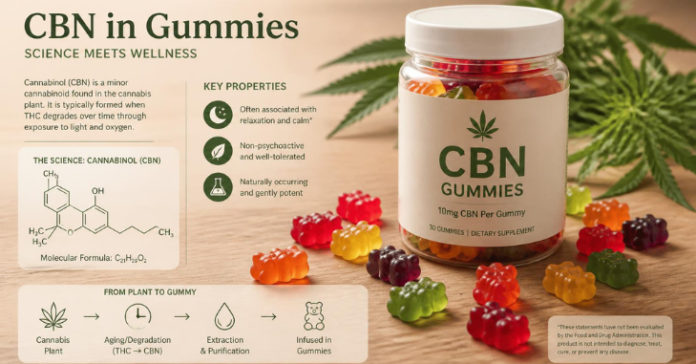
CBN is chemically distinct from cannabidiol (CBD) and from delta-9 tetrahydrocannabinol (THC). It is usually described as an oxidative breakdown product of THC, because it forms as THC is exposed to oxygen, light, heat and time — which is why aged cannabis tends to contain more of it. Researchers treat CBN as a cannabinoid in its own right rather than as a synonym for degraded THC.
For a side-by-side comparison, Nuturahey’s CBN vs CBD guide covers how the two differ in research depth, product positioning and sleep-related evidence. The practical difference is scale: CBD has been studied in hundreds of human trials, while CBN has two.
How Does CBN End Up in a Gummy?
Cannabis plants do not produce meaningful amounts of CBN while growing. It accumulates afterwards, as THC degrades. That single fact explains a lot about the retail market: CBN is harder and more expensive to supply at scale than CBD, which is abundant in hemp, so manufacturers source it in a few different ways.
- Natural degradation. CBN is isolated from aged or deliberately oxidised cannabis material. Yields are low and inconsistent.
- Chemical conversion. CBN is produced by converting hemp-derived cannabinoids in a lab. This is the most common commercial route and can leave residual solvents or unintended by-products if the process is poorly controlled.
- Full-spectrum extract. CBN appears as one component of a broader extract, at whatever concentration the source material happened to contain.
This matters to a buyer for one reason above all: the only way to know what is actually in the gummy is the batch test report. A product made by conversion should have a certificate of analysis that also covers residual solvents, not just cannabinoid content.
What Does CBN Do in a Gummy?
Manufacturers put CBN into gummies aimed at evening routines, relaxation and sleep support. That positioning built CBN’s reputation as the “sleep cannabinoid,” but a marketing category is not evidence. Two controlled human trials have now tested CBN for sleep. Both are worth reading closely, because both produced a more complicated result than the headlines implied — and because each one tested something a gummy buyer should care about.
What Do the Human CBN Sleep Trials Actually Show?
Here is the direct comparison first, then the detail on each trial.
| Bonn-Miller et al., 2023/2024 | Lavender et al., 2026 | |
| Journal | Experimental and Clinical Psychopharmacology | Journal of Sleep Research |
| Participants | 293 analysed, self-rated “poor” or “very poor” sleep | 20 adults with physician-diagnosed insomnia disorder |
| Doses | 20 mg CBN, alone or with 10, 20 or 100 mg CBD | 30 mg or 300 mg CBN, single oral dose |
| Duration | 7 consecutive nights | One night per condition, 2-week washout |
| How sleep was measured | Self-report | Overnight polysomnography plus self-report |
| Primary outcome | Sleep quality — not significant (OR 2.26, 95% CI 0.93–5.52, p = .082) | Wake after sleep onset — not significant (300 mg: −6.3 min, p = 0.29) |
| Significant secondary findings | Fewer awakenings (p = .025); less overall sleep disturbance (p = .023) | At 300 mg only: faster sleep onset (p = 0.004), better subjective sleep quality (p = 0.005), more NREM-2 sleep (p = 0.03), fewer EEG arousals (p = 0.02) |
| Adding CBD helped? | No — CBD did not augment the CBN effect | Not tested |
| Funding / affiliation | Authors affiliated with Canopy Growth Corporation and Wana Brands | Academic — Woolcock Institute, University of Sydney and Macquarie University |
The 2023 seven-night gummy trial
A double-blind, randomised, placebo-controlled study published online in October 2023 (and in the June 2024 issue of Experimental and Clinical Psychopharmacology) tested CBN in adults aged 18–55 who rated their own sleep as poor or very poor. Participants took placebo, 20 mg CBN, or 20 mg CBN combined with 10, 20 or 100 mg CBD for seven consecutive nights, 90 minutes before bed. In the modified intent-to-treat analysis of 293 people, 20 mg CBN significantly reduced the number of nighttime awakenings and overall sleep disturbance compared with placebo.
The headline that circulated at the time — “CBN improves sleep” — skipped the part that matters most. The trial’s primary endpoint was sleep quality, and it did not reach statistical significance. There was also no difference from placebo on sleep onset latency, wake after sleep onset, or daytime fatigue in any group.
Two further details are worth carrying into a purchase decision. First, adding 10 mg, 20 mg or 100 mg of CBD to the 20 mg of CBN did not improve the measured effect — a multi-cannabinoid label is not automatically a stronger product. Second, the study’s authors were affiliated with Canopy Growth Corporation and Wana Brands, both cannabis companies. That does not invalidate the findings, which were peer-reviewed, but it is context a reader deserves and that most CBN articles omit.
The 2026 laboratory insomnia trial
The second trial, published in the Journal of Sleep Research in 2026 (ClinicalTrials.gov NCT05344170), was smaller but methodologically stronger. Twenty adults aged 25–65 with physician-diagnosed insomnia disorder — meeting DSM-5 and ICSD-3 criteria, with an Insomnia Severity Index of 15 or above — each spent separate nights in a sleep laboratory after a single oral dose of 30 mg CBN, 300 mg CBN, or placebo. Sleep was recorded by overnight polysomnography rather than by questionnaire alone.
Neither dose significantly changed the primary outcome, wake after sleep onset. The 300 mg dose did improve several secondary measures: it shortened sleep onset latency, increased NREM-2 sleep, reduced EEG arousal indices, and improved subjective sleep quality. The 30 mg dose did not produce those changes.
Across all three arms the investigators logged 247 mild-to-moderate adverse events, with no serious adverse events and no withdrawals. Reported symptoms included fatigue, drowsiness, lethargy, dry mouth, dizziness, and nausea. The authors concluded that larger, longer trials are warranted — and they tested a single night only, which is a different question from what happens after a month of nightly use.
Where the two trials agree
Despite very different designs, the two studies line up on three points. Both missed their primary endpoint. Both found real, measurable effects on secondary sleep measures. And both used doses at or well above what a typical retail gummy delivers. That combination is the honest summary of the current evidence: something is happening, it is not yet clear how much of it a consumer product can reproduce, and nobody has tested long-term nightly use.
Are CBN Gummies Good for Sleep?
The accurate answer in 2026 is that CBN is promising but unproven as a treatment for insomnia. The 2023 trial found fewer awakenings and less overall sleep disturbance at 20 mg. The 2026 trial found no improvement in its primary wake-after-sleep-onset outcome, with several secondary gains at a 300 mg experimental dose that no retail gummy contains. Neither result supports treating a gummy as a substitute for insomnia care.
This matters because poor sleep has many causes. Stress, irregular schedules, caffeine, alcohol, pain, medication effects, sleep apnoea, restless legs syndrome, depression and anxiety all disrupt sleep in different ways and respond to different treatments. A gummy cannot tell you why you keep waking at 3 a.m., and sleep apnoea in particular will not improve because a cannabinoid was added to the evening.
Persistent insomnia deserves more than steadily increasing the dose of a supplement. Cognitive behavioural therapy for insomnia (CBT-I) remains the first-line treatment recommended by sleep medicine bodies, and a clinician can identify underlying conditions or medications that a gummy will not address. CBN research may eventually produce clearer answers; the current evidence does not justify presenting an over-the-counter gummy as insomnia treatment.
How Much CBN Is in a Typical Gummy?
This is the gap most CBN articles skip, and it is the single most useful thing to understand before buying. Retail CBN gummies commonly list anywhere from a couple of milligrams to around 10 mg of CBN per piece, often alongside a much larger CBD number and a few milligrams of melatonin. Some products list 20 mg or more. Both figures are worth putting next to the research.
| Dose | Where it comes from | What was observed |
| 30 mg | 2026 insomnia trial, low arm | No significant effect on any primary or secondary measure |
| 20 mg | 2023 gummy trial | Fewer awakenings and less overall sleep disturbance; primary sleep-quality outcome missed |
| 300 mg | 2026 insomnia trial, high arm | Faster sleep onset, better subjective quality, more NREM-2 sleep; primary outcome still missed |
Read that table in order and the implication is uncomfortable for the category: in the one trial that measured sleep objectively, 30 mg did nothing measurable — and a great many gummies on the shelf contain less than 30 mg. The 2023 trial’s 20 mg did produce effects, but on self-reported measures only.
Two cautions follow. Do not treat 300 mg as a target: it was a single laboratory dose given under supervision, not a consumer recommendation, and higher doses came with more reported side effects. And if a gummy that contains 5 mg of CBN alongside 3 mg of melatonin makes you sleepy, the melatonin is the more likely explanation. Compare the full ingredient panel, not the cannabinoid on the front of the box.
CBN vs CBD vs THC: What Is the Difference?
CBN, CBD and THC all belong to the cannabinoid family, but the names are not interchangeable. Their pharmacology, evidence base, product uses, intoxicating potential and regulatory treatment differ substantially. Checking the exact cannabinoid profile matters far more than assuming every hemp-derived gummy is broadly the same thing.
| Feature | CBN | CBD | Delta-9 THC |
| Full name | Cannabinol | Cannabidiol | Delta-9 tetrahydrocannabinol |
| Common source | Forms as THC oxidises; often lab-converted for commercial use | Occurs naturally in hemp in high concentrations | Occurs naturally in cannabis |
| Common retail positioning | Nighttime and sleep formulas | General wellness and relaxation | Intoxicating cannabis products |
| Strong THC-like high? | Not associated with the same strong high | No | Yes |
| Controlled human sleep trials | Two | Numerous, though results are mixed | Extensive research overall |
| FDA-approved prescription medicine based on it? | No | Yes — purified CBD for certain seizure disorders | Yes — THC-related medicines for specific indications |
| Commonly found in combination gummies? | Yes | Yes | Sometimes |
CBD’s deeper research history does not mean every retail CBD product has been proven effective, and that caution applies even more strongly to CBN. The FDA has repeatedly warned companies that cannabinoid products cannot be marketed as treatments for diseases without meeting drug requirements. In a 2024 warning letter, for example, the agency specifically addressed products promoted with CBD, CBG and CBN whose claims caused them to be treated as unapproved drugs. If a brand tells you its gummy treats a condition, that claim alone is a reason for caution.
Does CBN Make You High?
CBN should not simply be described as “THC without the high,” because the direct evidence is thin. In a small, older human experiment, 50 mg of CBN alone did not produce the drugged, drunk, dizzy or drowsy ratings observed with THC in five participants. Five people is not a basis for predicting how every person or every modern formulation will feel.
The larger practical issue is that a CBN gummy may contain other cannabinoids, including delta-9 THC. Full-spectrum products contain multiple compounds, and a product should be judged by its complete laboratory profile rather than by the largest word on the front label. A formula carrying enough THC can be intoxicating no matter how prominently CBN is branded.
Individual response also varies with dose, other ingredients, medications, alcohol, food intake and personal sensitivity. Anyone trying a cannabinoid product for the first time should not assume it is impairment-free because the package emphasises CBN. Both trials above recorded drowsiness, dizziness and lethargy among participants — so treat driving and any other task requiring alertness with caution.
What Should You Look for in a CBN Gummy?
A useful label tells you more than the total milligrams printed on the front. Look for the amount of CBN per gummy and per serving — those are not always the same number — along with CBD, delta-9 THC and any other cannabinoids. Then compare those figures against a recent certificate of analysis (COA) tied to the same batch or lot.
A COA shows whether the measured cannabinoid profile resembles what the manufacturer claims. Depending on the panel, it may also cover pesticides, heavy metals, residual solvents and microbial contamination. Nuturahey’s CBD store shopping guide explains how to assess batch-specific testing and other retailer transparency signals, and the hemp gummies reviews guide covers how edible formulas differ once you get past the front label.
Before buying, check these details on the label and the test report:
- CBN amount per gummy and per serving
- CBD and delta-9 THC content
- Full ingredient list, including melatonin, herbs and other actives
- Batch or lot number that matches the COA
- A recent third-party COA, with a visible testing date
- Contaminant testing — pesticides, heavy metals, residual solvents, microbes
- Serving size and directions
- State shipping or sales restrictions
- Whether the company avoids unsupported disease-treatment claims
Three red flags are worth naming outright. A COA with no batch number cannot be matched to the jar in your hand. A COA more than about a year old says nothing about current production. And a cannabinoid panel that omits delta-9 THC is not a reassurance — it is a missing number.
Are CBN Gummies Safe?
There is not yet enough long-term human research to describe CBN’s safety profile with the confidence available for established medicines. The 2026 insomnia trial recorded no serious adverse events among its 20 participants, but mild-to-moderate symptoms were common and the study tested single doses only. A short experiment in 20 people cannot answer questions about months or years of nightly use.
Combination products add complexity, because safety depends on every active ingredient. CBD can interact with medications and has been associated with liver-enzyme concerns at higher doses; THC can cause intoxication and impairment; melatonin has its own considerations. The National Center for Complementary and Integrative Health also notes that cannabinoid products may contain amounts that differ from their labels, or may contain contaminants.
People taking prescription medicines, living with significant medical conditions, pregnant or breastfeeding, or considering CBN for a persistent symptom should discuss cannabinoid use with a qualified healthcare professional. Children and pets should never have access to cannabinoid gummies, because candy-like products are easily mistaken for ordinary sweets — the FDA has repeatedly highlighted accidental-exposure risks with edible cannabinoid products. Nuturahey’s guide on whether you can overdose on CBD or hemp oil covers what is and is not known about excessive intake.
Can CBN Gummies Make You Fail a Drug Test?
Yes — a CBN gummy can create drug-testing problems even for someone who never intended to consume marijuana. The most obvious route is that a full-spectrum or inaccurately labelled product contains THC, and workplace cannabinoid panels look for THC metabolites. Nuturahey’s CBD and workplace drug-testing guide explains why cannabinoid labels cannot guarantee a negative result, and how long cannabinoids stay in your system covers detection windows.
CBN adds a second complication. A laboratory study found that CBN cross-reacted with two commercial urine immunoassays designed to screen for THC metabolites — although it took substantially more CBN than the target metabolite to trigger an equivalent signal. The researchers noted that confirmatory testing matters when an immunoassay result does not match a person’s known exposure.
Anyone whose job, athletic programme, treatment agreement or legal obligation requires a negative cannabinoid test should be cautious. A “THC-free” marketing claim does not eliminate risk from labelling errors, trace cannabinoids or screening cross-reactivity. Where the consequences of a positive test are serious, avoiding non-prescription cannabinoid products entirely is the only conservative position.
Are CBN Gummies Legal in the United States?
The answer depends on the product, how its cannabinoids were produced, its THC content and the state where it is sold — and the federal framework is actively changing as of late 2026. Federal hemp law has historically distinguished hemp by a delta-9 THC concentration of no more than 0.3% on a dry-weight basis, but Congress enacted substantial changes to that definition in 2025.
Those changes were then delayed. Legislation passed in September 2026 pushed most of the forthcoming hemp-definition restrictions back to 11 December 2026, which means the widely repeated November 2026 deadline no longer describes the federal position. Because CBN is generally produced from hemp-derived material, a narrowed federal hemp definition would affect CBN products directly. State law can be stricter than federal law regardless.
FDA requirements are separate again from whether a substance meets the federal definition of hemp. A product’s hemp status does not automatically make its medical claims, food use, labelling or interstate marketing compliant. Because this area is moving quickly, check current federal and state sources directly rather than relying on an older article — or on a retailer’s assurance that a gummy is “legal in all 50 states.”
CBN Gummies vs CBD Gummies: Which Should You Choose?
Neither cannabinoid is universally better, because the answer depends on why you are comparing them. CBD has a far larger evidence base across a range of uses; CBN is newer to controlled human sleep research and is strongly associated with nighttime formulas. Neither fact proves that a particular retail gummy will solve a health problem.
If sleep is the reason you are comparing them, do not assume that stacking cannabinoids makes a formula stronger. In the 2023 controlled trial, adding 10, 20 or even 100 mg of CBD to 20 mg of CBN did not improve the measured effect. The evidence behind a formulation is more meaningful than the number of ingredients on the label.
For everyday comparison, prioritise cannabinoid amounts, THC content, independent laboratory testing, added ingredients and responsible labelling. Nuturahey’s U.S. CBD gummies buying guide also covers COAs and product labels. If you are treating insomnia or another medical condition, professional advice beats choosing a gummy on marketing claims.
The Bottom Line
CBN in gummies means cannabinol has been added to an edible cannabinoid product, almost always one positioned for nighttime use. The human evidence now consists of two controlled trials. Both missed their primary sleep endpoint. Both found genuine effects on secondary measures — fewer awakenings and less overall sleep disturbance at 20 mg in 2023, faster sleep onset and better subjective quality at 300 mg in 2026. Neither establishes retail CBN gummies as a treatment for insomnia, and neither tested long-term nightly use.
Treat the label as the starting point of your research, not the answer. Check the CBN amount per gummy, the THC content, the other active ingredients, a batch-specific COA, contaminant testing, and the current state and federal rules where you live. And if sleep problems persist or you take prescription medicines, a healthcare professional is better placed than any product page to tell you whether a cannabinoid is worth trying at all.
Frequently Asked Questions
What does CBN stand for in gummies?
CBN stands for cannabinol, a cannabinoid found in cannabis and hemp. It forms as THC oxidises and degrades, although commercial producers often make it by converting other hemp-derived cannabinoids instead. When a package says “CBN gummy,” it means cannabinol has been added to that edible formula in a stated amount.
Is CBN stronger than CBD?
Calling one “stronger” is misleading, because CBN and CBD are different cannabinoids with different evidence bases and different effects. CBD has been studied far more extensively; CBN has a small but growing body of sleep-specific human research. Compare them on the specific outcome you care about rather than treating potency as a single universal scale.
How much CBN is in a typical gummy?
Retail CBN gummies commonly list from a couple of milligrams up to around 10 mg per piece, though some contain 20 mg or more. For context, the 2023 trial that found reduced nighttime awakenings used 20 mg nightly, and the 2026 laboratory trial saw no measurable effect at 30 mg. Many products therefore contain less CBN than the doses that have actually been studied.
Is CBN the same as melatonin?
No. CBN is a cannabinoid; melatonin is a hormone involved in regulating the sleep-wake cycle. They are unrelated substances. Many nighttime gummies contain both, which makes the full ingredient list important — if a product makes you drowsy, the melatonin may be doing most of the work.
How long does a CBN gummy take to work?
There is no established universal onset time for CBN specifically, because formulation, dose, digestion, food intake and individual biology all affect oral cannabinoid absorption. Gummies must be swallowed and digested, so effects appear more slowly than with inhaled products. In the 2023 trial, participants took their gummy 90 minutes before bed. Do not assume a product has failed because nothing happens immediately, and do not take additional servings faster than the label directs.
Can you take CBN and CBD together?
Products containing both are common, and researchers have formally tested the combination. In the 2023 randomised trial, adding 10, 20 or 100 mg of CBD to 20 mg of CBN did not improve the measured CBN sleep effect. That does not prove the combination has no value for any purpose, but it does mean adding CBD should not automatically be read as making a CBN gummy more effective.
Is CBN addictive?
Human research evaluating dependence or long-term repeated CBN use is essentially absent, so CBN cannot honestly be given a “zero risk” label on current evidence. The presence of THC or other psychoactive cannabinoids in a formula changes the question as well, so assess the entire cannabinoid profile rather than CBN alone.
Is it safe to take CBN every night?
Current studies are not strong enough to establish long-term safety. The longest CBN sleep trial ran for seven nights; the 2026 insomnia trial tested single doses on separate nights. Nobody has published data on months of nightly use. Anyone considering a regular habit — particularly alongside medications or for a persistent sleep problem — should discuss it with a healthcare professional first.
Does CBN show up on a drug test?
It can contribute to a positive screen in two ways: a CBN gummy may also contain THC, which is what most workplace panels target, and CBN itself has been shown to cross-react with some commercial THC-metabolite immunoassays, though only at relatively high concentrations. If a negative test matters to you, a “THC-free” claim is not sufficient protection.