

Searching for a CBD store can lead you to dedicated online retailers, local specialty shops, pharmacies, and general wellness sellers. The safest choice isn’t the retailer with the loudest wellness promise; it’s the one that gives you enough evidence to verify what you’re considering. In the United States, that means checking independent lab reports, labels, sourcing, current laws, and marketing claims before deciding.
Direct answer: A trustworthy retailer should make independent lab reports easy to find, show clear ingredient and cannabinoid labeling, explain product sourcing, and avoid disease-treatment promises. U.S. shoppers should also check current federal and state rules because important hemp-product requirements are changing during 2026.
Quick CBD Shopping Checklist
| What to check | What you want to see | Warning sign |
| Lab testing | Recent, batch-specific Certificate of Analysis | No report or an unrelated batch |
| Label | Cannabinoid amount, ingredients, warnings, batch details | Vague potency or missing ingredients |
| THC information | Clear amount supported by testing | Conflicting label and lab report |
| Retailer identity | Contact details, policies, responsive support | No clear way to reach the seller |
| Product claims | Factual, limited, responsible wording | Claims to cure or treat diseases |
| Legal information | State-aware shipping and product restrictions | Blanket legality claims with no caveats |
Key Takeaways
- Look for a batch-specific Certificate of Analysis, commonly called a COA.
- Compare the laboratory result with the batch or lot number on the product.
- Read the complete ingredient list instead of relying on front-label claims.
- Be cautious with retailers that promise treatment for pain, anxiety, cancer, insomnia, or other medical conditions.
- Check current federal rules and the law in your own state before relying on a retailer’s legality statement.
- Speak with a healthcare professional before use if you take medications or have health concerns.
How to Choose a CBD Store: Start With Verifiable Evidence
A good retailer makes important information easy to find before you have to contact customer service. Product pages should clearly identify ingredients, cannabinoid content, testing information, and the company responsible for the item. If you’re still learning the terminology, Nuturahey’s CBD101 educational library provides additional background on cannabidiol-related topics and products.
The strongest shopping signal is transparency rather than a polished website or a large catalog. A retailer can carry dozens of products and still give shoppers too little information to judge them responsibly. Focus first on evidence you can verify, then consider convenience, selection, or other secondary factors.
1. Demand Batch-Specific Independent Lab Results
A Certificate of Analysis is a laboratory report showing measured cannabinoid content and, when included in the testing panel, results for selected contaminants. The batch or lot information on the report should correspond with the item being evaluated. An unrelated or outdated report gives you much less useful information about the specific product in front of you.
Testing matters because labels and contents have not always matched across the retail market. The FDA says it has tested cannabinoid content in some products and found examples that did not contain the claimed levels, while also raising concerns about possible contaminants. A COA does not guarantee that a product is suitable for you, but it gives you more information than marketing copy alone.
When reviewing a report, check the following details.
- The product or batch identifier.
- The testing date.
- The name of the independent laboratory.
- Measured cannabidiol and THC content.
- Available pesticide, heavy-metal, solvent, or microbial panels.
- Whether the reported values broadly match the product label.
2. Read the Full Label Before Trusting Front-of-Pack Claims
The front label is designed to communicate quickly, while the detailed label tells you far more about what you may be using. Look for the amount per serving and per container, ingredients, serving information, warnings, and product identification details. If a product contains several cannabinoids, the label and lab report should make those components understandable rather than hiding them behind vague phrases.
Pay extra attention if avoiding THC is important to you. Terms such as “full-spectrum,” “broad-spectrum,” and “isolated” describe different formulation approaches, but the actual laboratory result deserves more weight than the category name. Nuturahey’s Simply CBD guide to cannabidiol can provide added background before you compare labels.
3. Check Who Is Behind the Product
A credible retailer should make it possible to identify the business and contact someone when questions arise. Look for a working contact method, understandable shipping terms, a privacy policy, and clear return or refund information. These details don’t prove product quality, but their absence makes accountability harder.
Be cautious when a site gives detailed wellness promises but little information about the company selling the item. Responsible sellers should also be able to explain where their product information comes from without inventing scientific certainty. Nuturahey’s CBD News section can help readers follow regulatory and industry developments that may affect these products.
4. Treat Disease-Treatment Claims as a Serious Red Flag
Retail cannabidiol products should not be presented as proven cures or treatments for diseases simply because they contain a cannabis-derived compound. The FDA states that it has approved only one CBD-containing prescription drug, Epidiolex, for specific seizure disorders. Other retail products have not received FDA approval as treatments for conditions such as anxiety, chronic pain, cancer, diabetes, or sleep disorders. For a closer look at this, see Key Differences in Effects.
That distinction matters when judging a retailer’s credibility. Claims promising to diagnose, prevent, cure, or treat a disease should make you more cautious, not more confident. A responsible seller should describe the product accurately without encouraging customers to replace appropriate medical care.
Online, Local, or General Wellness Retailer?
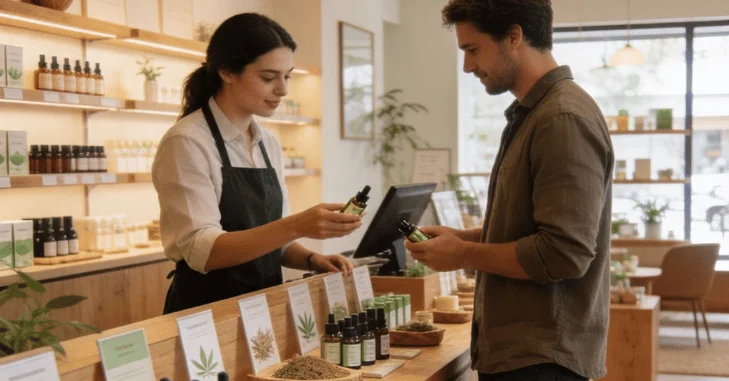
Different retail formats offer different advantages, so there is no single channel that automatically wins. An online specialist may make documents easier to compare, while a local shop lets you ask questions in person. A familiar pharmacy or wellness retailer may feel convenient but could offer a smaller range of products.
| Retail option | Potential advantages | Potential drawbacks |
| Online specialist | Easy document comparison, broad selection, detailed product pages | Shipping restrictions and no physical inspection before delivery |
| Local specialty shop | In-person questions and immediate label inspection | Testing documentation can vary by store. |
| Pharmacy or wellness retailer | Familiar shopping environment and established retail policies | Often a narrower selection |
| General marketplace | Convenience and many listings | Seller identity and documentation may be harder to verify. |
Verdict: Choose the retail channel that makes testing, labels, policies, and legal information easiest for you to verify. For many shoppers, a well-documented online specialist makes comparison easier, while a knowledgeable local retailer can be useful when you want to inspect packaging and ask questions. The evidence behind the item matters more than whether the transaction happens online or at a counter.
U.S. Hemp Rules Are Changing in 2026
Federal hemp policy deserves special attention this year because the rules are moving. Legislation enacted in 2025 created a new federal hemp definition and restrictions that were originally scheduled to take effect in November 2026. A federal funding measure signed in early September 2026 delayed most of those restrictions until December 11, 2026, while certain cannabinoids that cannabis cannot naturally produce remain subject to an earlier November deadline. Elsewhere on the site: Harvesting Cannabis in the U.S..
The familiar federal hemp framework has used a threshold of no more than 0.3% delta-9 THC on a dry-weight basis, but that statement alone no longer tells the whole 2026 story. Federal law also does not override every product rule imposed under the Food, Drug, and Cosmetic Act, and individual states can impose additional restrictions. Before relying on any retailer’s statement that an item is “legal everywhere,” check the most current rules that apply where you live.
A website’s ability to ship a package to your ZIP code is not the same thing as a legal determination. Product type, cannabinoid composition, age rules, and state restrictions can affect what is permitted. Because federal policy is changing quickly in late 2026, older articles may no longer give you enough information.
5. Look Beyond the Cannabidiol Number
A large number printed on the bottle does not tell you everything about quality. Ingredients, serving size, extract type, THC content, and testing information can be equally important. Comparing only the biggest potency number can cause you to miss meaningful differences between products.
This is especially useful when comparing gummies or other multi-ingredient formats because the cannabinoid extract is only part of the formulation. Nutrahey’s Will CBD Oil Make You Fail a Drug Test guide shows the kinds of product characteristics shoppers often compare across brands. Use reviews as supporting information rather than a replacement for labels and independent testing.
6. Check the Date of the Information You’re Reading
The date matters more in this category than it does for many ordinary consumer products. Federal policy changed in 2025 and again in September 2026, while states continue to develop their own approaches. A page written several years ago may describe rules that were accurate at publication but no longer provide a complete answer today.
The same principle applies to laboratory reports. A report from an old formulation or different batch should not be treated as proof for a new product. Recent information tied to the item you’re evaluating gives you a stronger basis for comparison.
7. Consider Medication and Health-Safety Questions Before Use
Retail availability does not mean cannabidiol is risk-free. The FDA’s consumer guidance on cannabis-derived products warns that it can interact with certain medications, may cause liver injury, and can increase sedation when combined with alcohol or other substances that slow brain activity. These concerns are a reason to discuss use with a healthcare professional when you take prescription drugs or have relevant medical conditions.
Pregnancy and breastfeeding require particular caution. The FDA strongly advises against the use of CBD, THC, and marijuana during pregnancy or while breastfeeding because significant safety questions remain. A retailer’s marketing should never take priority over that medical guidance.
8. Watch for Common Retail Red Flags
Weak retailers often reveal themselves through missing information rather than through one dramatic warning sign. Several small problems together can tell you that the seller is asking for more trust than it has earned. Leave more room for caution when you cannot independently confirm basic details.
Common red flags include the following problems.
- No accessible laboratory report.
- A COA that does not match the product batch.
- Missing ingredient or cannabinoid information.
- Disease-treatment or cure claims.
- No meaningful business contact information.
- Vague sourcing statements.
- Old testing used for a current formulation.
- Legal claims that ignore changing federal or state rules.
- Reviews presented without any other evidence of product quality.
A five-star rating cannot verify cannabinoid concentration or contaminant testing. Customer comments may help you understand service, packaging, or general experience, but they are not laboratory evidence. Treat reviews as one information source rather than the final quality check.
9. Use This 60-Second Retailer Check
You can screen a retailer quickly before spending more time comparing products. This process does not tell you whether cannabidiol is right for you, but it can expose missing information early. If the first few checks fail, you already have a reason to be cautious.
- Find the laboratory-testing section.
- Open the report for the specific product and batch.
- Compare the report with the label.
- Read the complete ingredient list and warnings.
- Look for clear company contact and policy information.
- Scan the page for unsupported medical promises.
- Check the latest federal and state rules that apply to you.
- Consider medication, pregnancy, or other health-safety concerns.
- Save the relevant product information before making your decision.
This simple process creates a repeatable standard that works across different retailers. It also keeps the focus on evidence instead of branding, discounts, or influencer endorsements. If a seller makes basic verification difficult, you have no obligation to keep evaluating it.
Make Transparency Your First Filter
Choosing a retailer becomes easier once you stop judging the market by branding alone. Start with testing, labels, company information, responsible claims, and current legal guidance, then compare the details that matter to you. That order gives you a more reliable way to separate transparent sellers from pages built mainly around marketing.
Nuturahey is designed as a CBD-focused educational resource rather than a substitute for professional medical or legal advice. Its goal is to help readers understand products, trends, and industry information so they can ask better questions. Keep checking current official sources as U.S. hemp policy develops through the remainder of 2026.
Frequently Asked Questions
A CBD store earns trust by making its products easier to verify rather than asking shoppers to accept broad promises. Look for batch-specific independent testing, clear ingredients, cannabinoid information, accessible company details, and responsible claims. No single feature proves quality, so evaluate several signals together.
A Certificate of Analysis, or COA, is a report from a laboratory that shows test results for a particular sample. Depending on the testing performed, it may cover cannabinoid concentrations and selected contaminants such as heavy metals, pesticides, or residual solvents. Check that the report is recent and corresponds with the product or batch you are evaluating.
There is no safe one-line answer that covers every product and every state. Federal hemp rules are changing during late 2026, and states can impose requirements that are different from federal rules. Check current official guidance for your state and the precise product category before relying on a seller’s nationwide-legality claim.
Neither format is automatically safer because both can carry well-documented or poorly documented products. Online retailers may make lab reports and labels easier to compare, while local shops let you inspect packaging and ask questions directly. Use the same evidence-based checklist regardless of where the seller operates.
The FDA warns that cannabidiol can interact with some medications, so this is a health question rather than a retail question. A salesperson or product page cannot assess your medications and medical history in the way a qualified healthcare professional can. Discuss potential use with your healthcare provider before combining it with prescription medicines.
Most retail products are not FDA-approved drugs. The agency says Epidiolex is the only FDA-approved prescription drug containing purified CBD, and it is approved for specific seizure disorders. Retailers should not imply that ordinary consumer products have the same approval or proven medical uses.