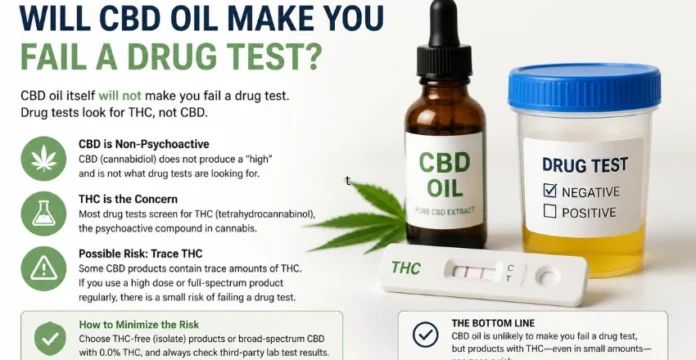
If you’re asking, “Will CBD Oil Make You Fail a Drug Test?” the answer is yes, it can, but CBD itself usually isn’t the reason. Standard workplace drug screens generally look for THC or its metabolites rather than cannabidiol. The risk comes from THC that may be present in a CBD product, even when the amount is small.
Direct answer: Yes, a CBD product can lead to a failed drug test, but CBD itself is usually not what triggers the result. Standard workplace tests look for THC or its metabolites. Full-spectrum products, mislabeled products, or repeated exposure to small amounts of THC can push a sample above a test’s cutoff.
| Key question | U.S.-focused answer |
| Do standard drug tests look for CBD? | Usually no. Cannabis panels generally look for THC or its metabolites. |
| Can full-spectrum CBD cause a positive result? | Yes. Full-spectrum products can contain measurable THC. |
| Are broad-spectrum products safer for testing? | They usually present less risk, but a “THC-free” label isn’t a guarantee. |
| Is CBD isolate lower risk? | Yes, if it contains only CBD and third-party testing confirms no detectable THC. |
| What is the federal urine screening cutoff for marijuana? | 50 ng/mL for the initial federal urine screen, followed by a 15 ng/mL confirmation cutoff. |
| Does legal hemp status guarantee a negative test? | No. Legality and drug-test detection are separate issues. |
TL;DR: What You Should Know
- Routine workplace tests generally target THC or THC metabolites, not CBD.
- Full-spectrum products carry the clearest risk because they may contain THC.
- Broad-spectrum and isolate products can reduce risk, but mislabeling or contamination can still occur.
- A hemp product can comply with legal THC limits and still expose you to enough THC for a positive result.
- Frequency of use, dose, product composition, metabolism, and test sensitivity all affect the outcome.
- If a negative drug test is essential to your job or legal status, avoiding nonprescription cannabinoid products is the lowest-risk option.
Why Will CBD Oil Make You Fail a Drug Test in Some Cases?
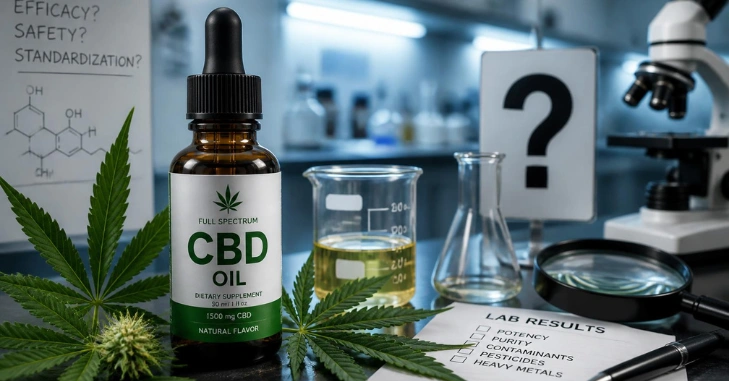
Will CBD oil make you fail a drug test? And THC is a different cannabinoid. A standard marijuana drug screen isn’t typically designed to identify cannabidiol. Instead, testing looks for THC itself or substances your body creates after processing THC. That distinction matters because many products sold as CBD contain more than cannabidiol. Full-spectrum extracts intentionally retain other plant compounds, which can include small amounts of delta-9 THC.
A 2026 systematic review examined research on CBD and hemp oils and drug testing. The authors found that positive cannabinoid findings were mainly linked to product composition, undeclared THC, contamination, administration route, and test sensitivity.
Johns Hopkins researchers have also shown the difference between pure CBD and THC-containing hemp products. In one controlled study, pure CBD did not produce confirmed positive urine results under federal workplace cutoffs. Low-THC cannabis did produce confirmed positives in some participants.
What Drug Tests Are Looking for
For marijuana testing, the main concern is exposure to THC. In the federal U.S. workplace program, the current SAMHSA federal drug testing guidance lists a 50 ng/mL initial urine cutoff for the marijuana metabolite and a 15 ng/mL confirmatory cutoff. Federal oral-fluid testing uses separate thresholds.
Private employers, medical programs, courts, athletic organizations, and state agencies may use different testing methods or policies. A negative result under one program doesn’t guarantee the same result under another.
The important point is simple: a drug test does not need to confuse CBD with THC for a problem to occur. If the product contains THC, your body can produce the exact metabolites the test is designed to find.
For more background on the relationship between cannabinoids, Nuturahey’s guide explaining how THCA turns into THC provides useful context on how different cannabis compounds relate to THC.
Drug-Test Risk by CBD Product Type
The type of product you use can change your chance of THC exposure.
| Product type | THC expectation | Drug-test risk |
| Full-spectrum CBD | May contain trace THC | Highest among common CBD types |
| Broad-spectrum CBD | THC is intended to be removed. | Lower, but not zero |
| CBD isolate | Intended to contain CBD alone | Lowest when accurately manufactured and tested |
| Poorly labeled or untested product | THC content may be uncertain. | Unpredictable |
| Hemp seed oil | Made from hemp seeds and is different from cannabinoid-rich CBD extracts | Generally, it is not the same THC concern as a CBD extract. |
Full-spectrum products deserve extra attention. Quest Diagnostics reported on a small study in which participants took a full-spectrum, hemp-derived extract for four weeks. Seven participants produced positive THC urine results. Broad-spectrum products are usually processed to remove THC. CBD isolate goes a step further by separating cannabidiol from other cannabinoids. Still, what appears on the label may not always match what is inside the bottle.
The FDA has warned that some marketed CBD products have not contained the cannabinoid levels stated on their labels. The agency has also raised concerns about possible THC and other contaminants. Before choosing any extract, compare the label with a recent certificate of analysis from an independent laboratory. Nuturahey’s discussion of CBD product testing and transparency explains why third-party testing matters when evaluating a product.
Why “Legal Hemp” Does Not Mean “Drug-Test Safe”
People often assume a legal hemp product cannot create a workplace testing problem. That assumption mixes two separate standards. Federal rules have defined hemp using a THC concentration threshold. Drug tests work differently. They measure a substance or metabolite in your biological sample and compare that result with the testing program’s cutoff.
A product can contain a small amount of THC without making a user feel intoxicated. That doesn’t mean the THC is invisible to laboratory testing. Repeated use can increase total exposure. Product potency, serving size, frequency, your metabolism, and the test method all affect the final result.
SAMHSA’s current federal workplace materials make this risk especially clear. The 2025 case studies describe a donor who reported legal CBD use after a marijuana-positive test. The CBD explanation did not change the federally reported result to a negative value.
That rule applies specifically to federal workplace testing. Private employer policies and state protections can differ, so review the policy that applies to you.
How Long Can THC From a CBD Product Be Detectable?
There is no single reliable number of days that guarantees THC from a cannabinoid product will be gone before a drug test.
Detection depends on several factors:
- how much THC the product contains;
- How much product do you use
- whether you use it once or repeatedly;
- the type of specimen being tested;
- individual metabolism and body composition;
- the laboratory’s screening and confirmation thresholds.
This is also why online claims promising that you’ll be “clean” after a fixed number of hours or days should be treated cautiously. The issue becomes even harder when the true THC content isn’t known. A label that says “hemp,” “broad-spectrum,” or “THC-free” does not tell you what a laboratory will find in your body.
The safest approach is not to rely on detox drinks, excessive water intake, or other methods marketed as ways to beat a test. They don’t provide a dependable negative result and may create other testing problems.
How to Lower the Risk of an Unexpected Positive Result
If drug testing could affect your employment, professional license, security clearance, athletics, treatment program, or legal obligations, start by understanding the testing policy.
For people who still choose to use a CBD product, these steps can reduce uncertainty:
- Check the product type. Full-spectrum formulas can contain THC.
- Read the certificate of analysis. Look for recent third-party cannabinoid test results associated with the product’s batch or lot.
- Check the THC result, not only the CBD amount. “Hemp-derived” alone doesn’t answer the testing question.
- Be cautious with “THC-free” claims. Confirm them with independent laboratory data.
- Avoid assuming one serving is risk-free. Exposure can vary by dose and frequency.
- Know your employer or program’s rules. Federal, state, and private testing policies are not identical.
Nuturahey’s review of CBD extracts and quality standards covers several product-quality factors worth checking before choosing an extract.
The same THC issue can apply to edible cannabinoid products. If you use gummies, Nuturahey’s hemp gummies review guide can help you understand the product category and what to examine on labels. If a negative result is essential, the most conservative choice is to avoid nonprescription CBD and other cannabinoid products before and during periods when you are subject to testing.
What Should You Do After a Positive Test?
First, follow the formal review process for the testing program rather than assuming the result is final. Federal workplace programs use a Medical Review Officer, or MRO, to evaluate laboratory results and relevant medical information. Federal employees and workers in covered safety-sensitive industries may also have rights involving a retained split specimen.
If you used a CBD product, keep the container, receipt, lot number, and certificate of analysis. Those records may help document what you used, although they do not guarantee that a positive result will be reversed. For federal workplace testing, SAMHSA specifically warns that CBD use can be consistent with a marijuana-positive result without serving as an acceptable medical explanation.
For a private employer, union workplace, court program, sports organization, or state-regulated position, check the rules that govern that program. Consider speaking with an employment attorney or qualified medical professional when the consequences are significant.
The Bottom Line
CBD itself is usually not the substance that causes a marijuana-positive workplace screen. THC exposure is the main concern, including trace THC in full-spectrum products or unexpected THC caused by inaccurate labeling or contamination. If you are wondering if CBD oil will make you fail a drug test, the possibility depends largely on whether the product exposes you to enough THC for the testing method to detect it.
Current research shows that positive results are possible, not inevitable. Your risk depends on the product, THC content, frequency of use, and the testing method.
If passing a drug test is essential, don’t treat a “legal,” “hemp-derived,” or “THC-free” label as a guarantee. Review laboratory testing, understand the rules that apply to you, and avoid cannabinoid products when you cannot accept the risk of a positive result.
Frequently Asked Questions
Pure cannabidiol should not create the THC metabolites that standard marijuana tests look for. The problem is proving that a consumer product contains no THC. Manufacturing variation, contamination, or inaccurate labeling can increase the risk.
CBD itself usually isn’t the target. Common workplace panels can include marijuana testing, which looks for THC or THC metabolites. A CBD product containing THC may therefore lead to a positive cannabis result.
Yes. Full-spectrum formulas may contain trace amounts of THC. Research reviewed by Quest Diagnostics has shown positive urine THC results in some people after repeated use of a full-spectrum hemp extract.
No. Broad-spectrum products are intended to have THC removed, so the risk is generally lower than with full-spectrum products. Mislabeling and contamination mean no retail product can guarantee your test result.
Yes. Legal status does not determine whether a laboratory detects THC or its metabolites. SAMHSA warns federal workers that hemp-derived products can still create a positive marijuana test.