

Indica CBD oil usually refers to a hemp-derived tincture marketed with an indica-style cannabinoid or terpene profile. The name often suggests relaxation or evening use, but the label alone cannot predict effects. U.S. buyers should focus more on cannabinoid content, THC levels, laboratory testing, ingredients, and personal safety factors.
Direct answer: An indica label does not prove that a CBD product will make you relaxed or sleepy. Current research finds indica and sativa labels are poor predictors of cannabis chemistry and effects. Check the actual CBD amount, THC content, terpene profile, ingredients, and independent laboratory report before choosing a product.
Indica-Labeled Hemp Oil at a Glance
| Question | What U.S. buyers should know |
|---|---|
| What does “indica” mean? | It is mainly a consumer-facing cannabis classification, not a reliable effect guarantee. |
| Does CBD cause a high? | CBD itself is not intoxicating, according to the CDC. |
| Can these products contain THC? | Yes, especially full-spectrum formulas. |
| Does indica automatically mean sleepy? | No. Individual response and product chemistry matter more. |
| Can CBD affect drug testing? | THC in a product can create a risk of a positive test. |
| Should buyers check lab reports? | Yes. Look for recent, batch-specific cannabinoid and contaminant results. |
| Are CBD products FDA-approved medicines? | Most retail products are not FDA-approved drugs. |
| Do state rules differ? | Yes. State requirements can differ from federal rules. |
Key Takeaways
- Don’t treat “Indica” as a scientific guarantee of relaxation or sedation.
- CBD does not create the intoxicating high normally associated with THC.
- Full-spectrum products can contain measurable THC and may matter for drug testing.
- A recent Certificate of Analysis should confirm cannabinoid levels and contaminant screening.
- CBD can cause drowsiness and can interact with medications.
- U.S. buyers should check both federal guidance and their current state rules.
- Product chemistry provides more useful information than an indica or sativa label.
What Does “Indica” Really Mean on a CBD Product?
Cannabis companies have long used indica, sativa, and hybrid labels to describe products and expected experiences. Consumer marketing commonly associates indica with calmer or more sedating effects. That association should not be confused with a reliable chemical classification.
A 2026 systematic review examined evidence behind these familiar labels. It found limited agreement between the labels and genetic structure or major cannabinoid profiles. Human evidence also did not support dependable label-based predictions about effects.
Earlier U.S. research reached a similar conclusion after examining commercial cannabis chemistry. Researchers found that common industry categories aligned poorly with underlying chemical composition. That means two products carrying the same category can still have meaningfully different cannabinoid and terpene profiles.
For shoppers, the practical lesson is simple. Read the measurable product information before relying on the strain category. Potency, THC concentration, ingredients, serving size, and laboratory results provide more useful purchasing information.
Does an Indica Label Mean the Product Will Make You Sleepy?
Not necessarily, because an indica designation cannot reliably predict a person’s response. CBD itself can cause drowsiness or sleepiness in some users. Other people may notice little change in alertness.
The FDA warns that cannabidiol can affect alertness and interact with other substances. Alcohol and medications that slow brain activity may increase drowsiness. Nuturahey’s guide to CBD-related tiredness explains these factors in greater detail.
Additional ingredients can also change the experience. Some nighttime formulations contain THC, CBN, melatonin, or particular terpene blends. Always review the complete ingredient panel before assuming cannabidiol caused an effect.
Avoid driving or operating machinery if a product makes you sleepy or less alert. New users also shouldn’t assume a marketing category determines safe timing. Your response can differ from another person’s experience with the same product.
CBD, THC, and Full-Spectrum Products Are Not the Same
CBD and THC are both compounds found in cannabis, but they have different effects. The CDC states that cannabidiol itself is not impairing and does not produce a high. THC is the compound more closely associated with cannabis intoxication.
Full-spectrum hemp extracts can include CBD alongside other naturally occurring cannabinoids and terpenes. They can also contain THC within applicable legal limits. That detail matters for people who want to avoid THC exposure.
Broad-spectrum products are generally formulated to include multiple hemp compounds while removing THC. CBD isolate contains cannabidiol without the wider cannabinoid mixture. Actual contents still need verification through reliable laboratory testing.
Common Product Types Compared
| Type | Typical cannabinoid profile | Main advantage | Main concern |
|---|---|---|---|
| Full-spectrum | CBD plus other cannabinoids and possible THC | Wider plant-compound profile | THC exposure and drug-test risk |
| Broad-spectrum | Multiple cannabinoids with THC removed or minimized | Broader profile with less THC exposure | Trace THC may still require verification |
| CBD isolate | Primarily cannabidiol | Simpler cannabinoid profile | Fewer additional plant compounds |
| Indica-terpene formula | CBD product with an indica-style terpene blend | Specific flavor or aroma profile | Label does not guarantee a specific effect |
Pros and Cons of an Indica-Style Formula
Potential advantages
- May offer a terpene profile designed around an evening-oriented product concept.
- Full-spectrum versions can contain several naturally occurring hemp compounds.
- Oils allow shoppers to compare milligrams per serving with reasonable precision.
- Laboratory reports can provide detailed information about cannabinoid composition.
Potential drawbacks
- The indica label does not reliably predict relaxation or sleep.
- Full-spectrum formulas may contain THC.
- Retail product quality and labeling accuracy can vary.
- CBD can cause side effects or interact with medications.
- A THC-containing formula can create workplace or legal testing concerns.
How to Choose Indica CBD Oil More Carefully
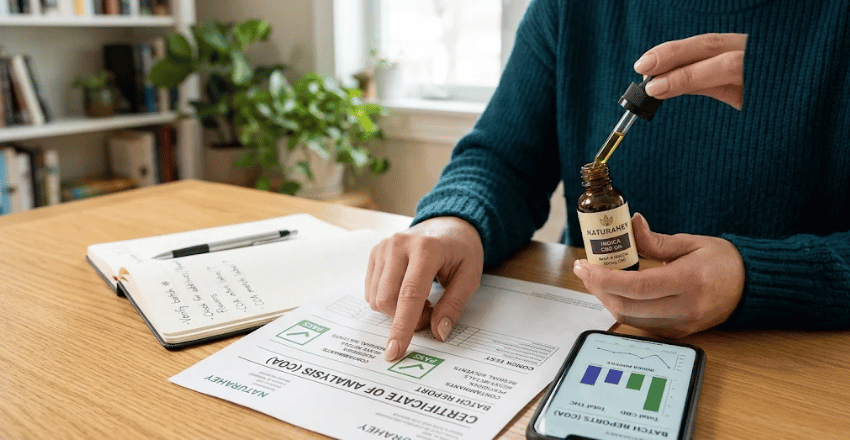
Start with the Certificate of Analysis, often shortened to COA. A useful report should correspond with the product’s current batch or lot. Nuturahey’s CBD store shopping guide explains nine checks for evaluating retailers and laboratory information.
Next, compare the label with the laboratory report. Look at total cannabidiol, THC, serving size, and other measured cannabinoids. Avoid relying entirely on front-label words such as “calm,” “night,” or “indica.”
Review contaminant testing when the laboratory provides it. Depending on the report, testing can cover pesticides, heavy metals, microbes, or residual solvents. A cannabinoid result alone does not answer every product-quality question.
Finally, check the ingredient list for substances beyond hemp extract and carrier oil. Added melatonin, botanicals, flavors, or other cannabinoids can change the product’s practical use. They may also introduce separate safety considerations or interactions.
Which Type Makes the Most Sense?
For someone who wants the broader hemp profile and accepts some THC exposure, full-spectrum may fit the goal. That choice deserves extra caution when workplace testing matters. The word “indica” should remain secondary to verified cannabinoid measurements.
Broad-spectrum formulas may suit shoppers trying to reduce THC exposure while retaining several hemp compounds. Still, a label claiming zero THC should be checked against the batch report. Testing quality matters more than category wording.
CBD isolate offers the simplest cannabinoid profile for people primarily interested in cannabidiol. It does not eliminate every safety consideration or guarantee a negative drug test. Manufacturing quality, contamination, and labeling accuracy still matter.
Verdict: Choose based on laboratory-confirmed chemistry rather than the indica label alone. Full-spectrum formulas suit buyers comfortable with documented THC exposure, while broad-spectrum or isolate may better fit THC-conscious shoppers. People facing strict drug testing should understand that no retail hemp product can guarantee a negative result.
Can These Products Cause a Positive Drug Test?
Standard U.S. marijuana tests generally focus on THC or its metabolites rather than CBD itself. A full-spectrum hemp product can still expose someone to enough THC to create risk. Repeated use can make that concern more relevant.
Nuturahey’s guide on CBD and positive drug tests covers the major risk factors. These include THC content, inaccurate labeling, contamination, and repeated exposure. A “legal hemp” label does not automatically equal “drug-test safe.”
Detection and impairment are also different questions. A compound can remain measurable after noticeable effects have ended. Read Nuturahey’s explanation of how long cannabidiol can remain in the body for more context.
Is CBD Legal Across the United States?
Federal law removed qualifying hemp from the federal Controlled Substances Act under the 2018 Farm Bill. As the FDA explains, the federal hemp definition covers cannabis with no more than 0.3% THC on a dry weight basis. Product legality still involves more than that single threshold.
The FDA retains authority over products containing cannabis-derived compounds. The agency also states that most retail cannabidiol products have not received FDA drug approval. Companies cannot legally market unapproved products as disease treatments.
State laws can impose additional restrictions on hemp products, cannabinoids, sales, or shipping. These rules matter because federal and state policies keep changing. Check current requirements where you live before purchasing or traveling with a cannabinoid product.
Safety Issues U.S. Buyers Should Know
CBD is widely available, but availability does not mean zero risk. The FDA identifies possible concerns, including liver injury, drug interactions, and drowsiness. Product quality can also differ across the consumer market.
Talk with a healthcare professional before use when you take prescription medications. A pharmacist can also help identify possible drug interactions. Do not stop or change prescribed treatment because of information found on a retail label.
The FDA strongly advises avoiding CBD, THC, and marijuana during pregnancy or breastfeeding. Consumers with significant health conditions should seek individualized medical advice before use. Retail products should never replace established medical treatment without professional guidance.
Frequently Asked Questions
Does indica CBD oil make you sleepy?
It can make some people feel sleepy, but the indica label does not guarantee that effect. CBD itself can cause drowsiness in some users. THC, other ingredients, medications, alcohol, and individual sensitivity may also influence alertness.
Is indica better than sativa for relaxation?
Current evidence does not support using those labels as reliable predictors of effects. A 2026 systematic review found inconsistent links between consumer-facing categories and human outcomes. Measured chemistry and individual response provide better information.
Can a hemp-derived tincture contain THC?
Yes, particularly when the product is full-spectrum. The label should show the amount, and laboratory testing should confirm it. People avoiding THC should inspect both sources carefully.
What should I look for on a COA?
Check that the batch or lot matches your product. Review measured CBD, THC, and other cannabinoid concentrations. Look for contaminant testing and the laboratory’s identifying information when available.
Is CBD approved for treating anxiety or insomnia?
The FDA has not approved ordinary retail cannabidiol products for treating anxiety or insomnia. The agency has approved one prescription CBD medicine for specific seizure disorders. Wellness marketing should not be treated as evidence of an approved medical use.
The Bottom Line for U.S. Buyers
An indica-style tincture can be a legitimate product category, but the word on the label provides limited scientific information. Modern research shows that traditional strain categories do not consistently predict chemistry or effects. Buyers get better information from verified cannabinoids, THC content, ingredients, serving details, and laboratory testing.
Consider your own medication use, sensitivity, driving responsibilities, and workplace testing requirements before choosing a product. Check current state requirements because cannabinoid rules vary across the country. Seek professional advice when health conditions, prescriptions, pregnancy, or recurring side effects are involved.
For your next comparison, use a batch-specific COA as the starting point rather than a strain name. Nuturahey’s CBD resources can help you examine testing, product labels, drug-test concerns, and safety factors. A careful comparison can tell you far more than “indica” printed on the front of a bottle.